
Delaware Previous Residents by Era
Delaware previous-resident research is a dated evidence trail, not a guessed household list. Begin with the Delaware source closest to the time period in question. The Delaware Recorder can supply the legal instrument trail, while the Delaware Auditor and Delaware GIS supply the parcel link that helps distinguish one property from another. Delaware’s digitized directory collection is unusually useful because several volumes provide a street-and-householder route as well as an alphabetical route. Census, newspapers, maps, probate material, and cemetery records can add Delaware historical context, but each has a different purpose and level of certainty.
| Source | Years | Where | What It Shows |
|---|---|---|---|
| Recorder land index | Generally 1990 to present online | Delaware County Recorder | Recorded deeds, party roles, instruments, and legal-description links |
| Auditor and GIS parcel tools | Current parcel record | Delaware County GIS | Parcel, address, owner, value, conveyance, and map context |
| Ohio Memory directories | 1859 to 1922 digitized sequence | DCHS Ohio Memory collection | Dated city, street-guide, and householder references |
| Local archive shelves | Collection and volume dependent | DCDL Local History Room | Directories, maps, census tools, Gazette microfilm, and local-history files |
| Federal census | 1790 to 1950 available for research | National Archives | Household context on an enumerator date, not an address-history guarantee |
| Records Center series | Varies by record type | Delaware County Records Center | Historic marriage, vital, probate, road, commissioner, and court series |
Start a modern Delaware address with its Delaware parcel number, then preserve the legal description before moving backward. Start an older Delaware address with the correct directory year and page. A Delaware volume date, map date, or recorded date is the key that keeps past residents from being mistaken for current ones.
Delaware Previous Resident Parcel Starts
The Delaware County Auditor property search and Delaware County GIS are the proper opening for a Delaware property-specific question. Keep the Delaware parcel number, assigned address, conveyance date, subdivision or plat references, and legal description with the search notes. The Treasurer’s tax-account route can be useful for parcel context, but a tax mailing address is not evidence that someone lives at the property.
Delaware GIS separates Address Point, Street Centerline, Parcel, Municipality, Annexation, and ZIP Code layers. They can differ in date or scale. A current Delaware parcel string that resembles an old directory number is not enough to prove continuity. For a disputed Delaware location, compare the historic street guide, historic map, Delaware Recorder legal description, present parcel, and municipal or annexation layers before describing the address trail as continuous.
Note: Treat a parcel number as the cross-source key, while preserving the historic street wording exactly as its dated source prints it.
Trace Delaware Previous Residents Through Deeds
A Delaware deed chain records land transactions, not a direct occupancy timeline. It may show a grantor, grantee, lender, heir, trustee, or another party at a stated date. Do not convert those roles into a claim that a person lived at the address. Delaware County Recorder material is searchable by name, tract, book and page, or instrument number. The Delaware online real-estate document boundary is generally 1990 to present, with office research needed for pre-1990 material and for any later record that was not computerized.
- Find the present parcel in the Delaware Auditor or GIS system and copy the parcel number and legal description into a dated research note.
- Search the current recorded owner or known party in the Recorder index, then identify the purchase instrument by type, recording date, and number.
- Read the Delaware party roles. Search the seller as a grantee to locate that party’s earlier acquisition, while checking the parcel or legal-description link.
- Repeat backward, keeping an instrument number, recording date, role, and the exact legal-description context at every step.
- When the online index ends or lacks the needed document, ask Recorder staff for the applicable office-research, book, page, or historical-media route.
- Grantor
- The party conveying an interest in the recorded instrument.
- Grantee
- The party receiving an interest in the recorded instrument.
- Chain of title
- A sequence of recorded transfers connected by party roles, dates, and property identifiers.
- Legal description
- The land description used in an instrument. It can remain more stable than a street address when address styles change.
Delaware Previous Resident Street Guides
Delaware’s directory volumes make historical address research more precise than an alphabet-only search. The Delaware 1901 Danford and McCuskey volume places Street and Number at pages 101 through 123. Delaware Baker’s 1905-06 volume places Street Guide and Householders at pages 177 through 208, then lets the reader cross-check an alpha city entry at pages 17 through 146. In Delaware 1908-09, the Street Guide and Householders appear at pages 15 through 45 before the city directory. The Delaware 1922 volume has Street Guide and Householders at pages 15 through 54.
The 1905-06 Baker’s directory is shown below because it preserves both a street route and an alphabetical route. Use the street page first, capture the printed spelling and page, then check the matching name entry in the same dated volume.
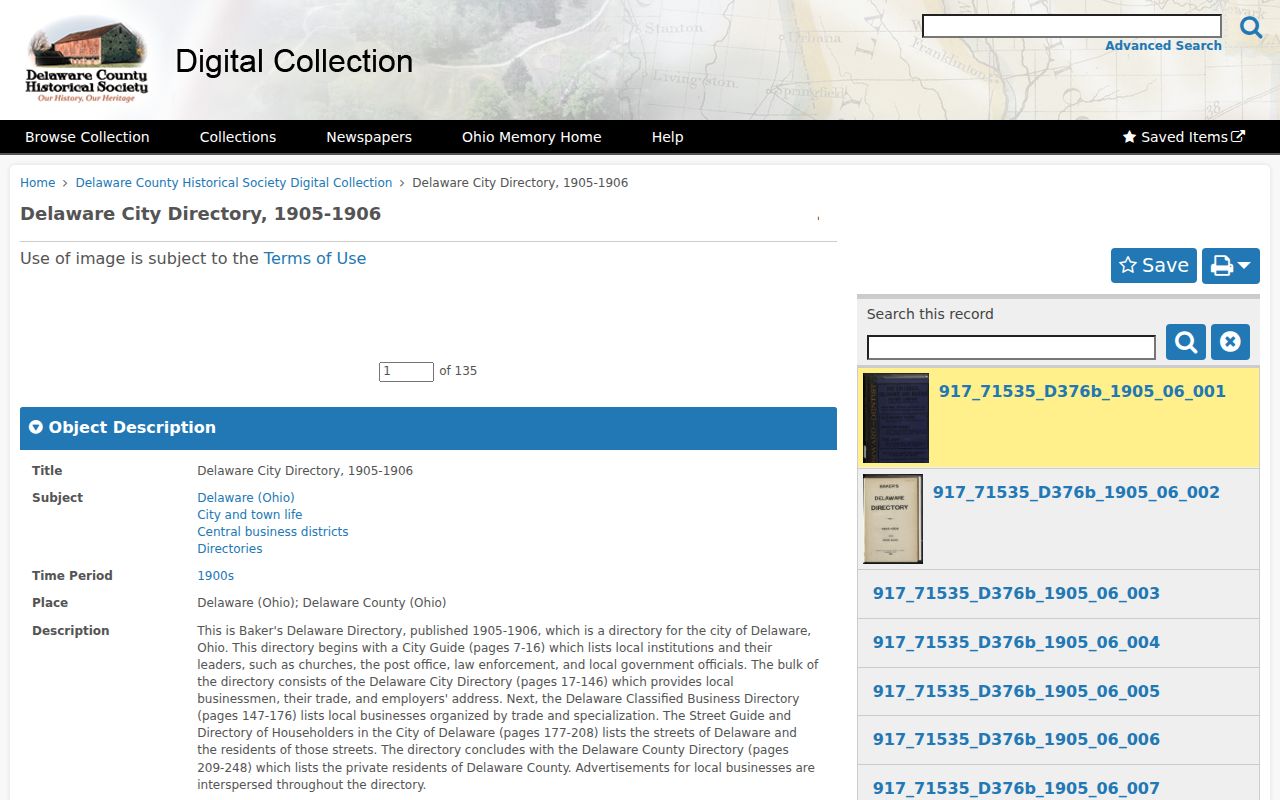
That two-part check supports a historical address citation. It does not make a dated householder entry proof of current residence or a family relationship.
The Delaware city directory page describes the collections themselves. For an address trail, use a volume only as one dated step in the backward sequence.
Pair Delaware Previous Residents With Census
Directory and census evidence serve different roles. A Delaware directory may place a named householder at a printed street number for its volume year. A Delaware census source captures household context on an enumerator date. The National Archives says federal censuses from 1790 through 1950 are available for research, subject to the 72-year release practice. Neither source should be used to fill a missing year with a guess.
The National Archives census overview below is the federal context route. Pair a census result with the closest available Delaware directory, map, or newspaper citation, and keep the different record dates visible.
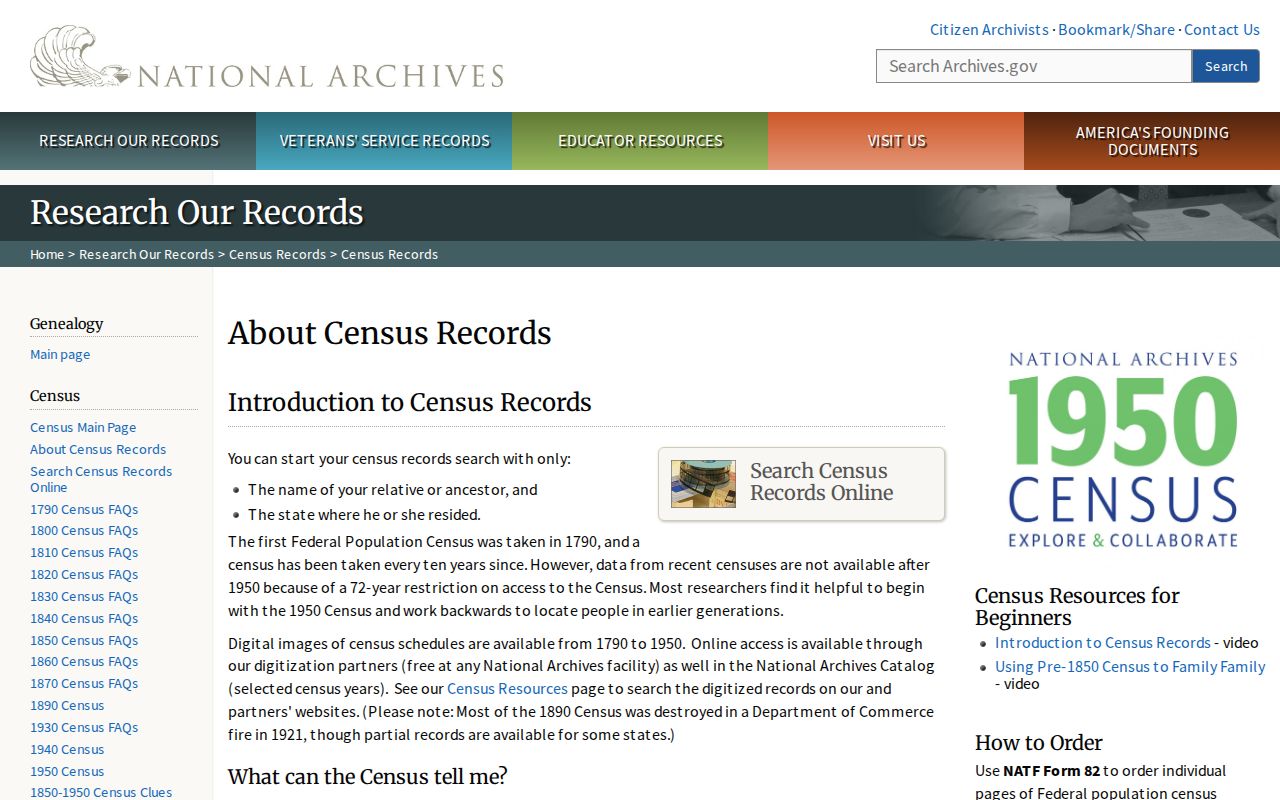
Use this flow when the sources support it: historic address or street guide, then alpha directory entry, then census household context, then a map or parcel check. Each source contributes one dated observation rather than a complete personal timeline.
Delaware Previous Address Continuity Tests
Delaware historic addresses can fail a simple string match. A road can be extended, a number can change, and a county directory section can be mistaken for a City entry. Research found no official City-wide table that resolves every historical street-name change or renumbering. The correct response is not to invent a conversion. Compare the Delaware street guide, 1866 atlas or other historic map, Recorder legal description, current parcel, and current municipal layers, then state the remaining uncertainty.
Address continuity uncertain. When a historic number and current parcel cannot be corroborated by a map, legal description, or another dated source, preserve both forms without declaring them the same place.
The 1866 county atlas item is historical map evidence, not survey proof. The GIS viewer is also in transition, and the County cautions that geometry in a replacement viewer can lag recent changes. Record the display date for a map and use the official map on file for a binding zoning question.
Delaware Past Resident Trail Endpoints
Records often add context at the end of a Delaware address trail without proving occupancy. Delaware Probate estate files can document a dated legal relationship to property. The Delaware Records Center identifies probate material from 1850 to 1950, while Probate reports different access and media periods for estate records. DCDL provides Delaware Gazette microfilm from 1821 to the present, and DCHS has newspapers, atlases, yearbooks, and personal archives. Newspaper and obituary references must retain publication title, issue date, page or frame, and the source repository.
For a historic death, the Ohio History Connection death-research route distinguishes its 1908 through 1970 collection from older county-ledger material. It is a useful date check, not a substitute for a certificate or proof of a past street address.
Oak Grove burial information can also supply historical cemetery context for deceased people, but a section, lot, or grave does not identify a former residence or living relatives.
Lawful Delaware Previous Resident History
House history can support family research, preservation work, estate questions, and personal curiosity when every source stays in its proper time and scope. It should not become a directory of living people. Never combine a name with an exact address and contact detail, publish a road-by-road person list, or use a past household entry as a current claim. The most useful research note records the source type, source date, original address text, parcel or legal-description link where available, repository, and an uncertainty flag.
Lawful use. Delaware previous-resident research is for lawful house and family history. Do not use historic or current records to stalk, harass, target, or expose anyone.
Delaware Previous Residents Office Fallbacks
When a document is not online, ask the office that holds the record for the exact historical route. Recorder research belongs with the Recorder at 145 North Union Street. The Records Center at 2079 U.S. Highway 23 North holds identified historical series, but it does not replace every current custodian. DCDL Local History and the Delaware County Historical Society can help locate a volume, map, microfilm run, or archival collection when the date and record type are already known.
For a records request, identify the existing record, a narrow date range, and a preferred copy format. Delaware County accepts requests by email, phone, mail, in person, verbal request, or its offered form. The county does not have to create a new record or conduct an undefined search. That boundary helps preserve a careful, source-based trail for Delaware previous residents.
Note: Record the custodian and retrieval date with each item so a later researcher can distinguish an official instrument from archival context.